QUALITATIVE APPROACH TO HOMELESSNESS. Towards more inclusive policies in Croatia published by the Pilar Institute

As its 51st book of the Studije /Studies/ Series, the Ivo Pilar Institute of Social Sciences published a study by Lynette Šikić-Mićanović, Paula Greiner and Matija Krizmanić KVALITATIVNI PRISTUP BESKUĆNIŠTVU. Prema inkluzivnijim politikama u Hrvatskoj / QUALITATIVE APPROACH TO HOMELESSNESS. Towards more inclusive policies in Croatia
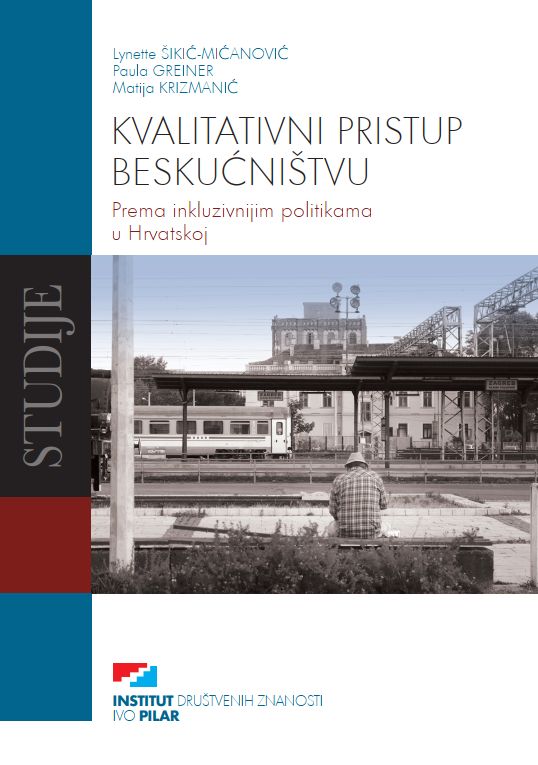
Authors: Lynette Šikić-Mićanović, Paula Greiner, Matija Krizmanić
Title in English: QUALITATIVE APPROACH TO HOMELESSNESS. Towards more inclusive policies in Croatia
Series: STUDIES – Book 51
Publishers: Ivo Pilar Institute of Social Sciences
Place of publication & number of pages: Zagreb, 2025 – 242 p.
ISBN 978-953-8404-37-5
From reviews
This book, like the research, is meticulously and thoughtfully designed. As a valuable contribution to homelessness research in Croatian scholarship, it aligns well with the global body of recent works on homelessness from a social-humanistic perspective. Throughout the text, it also subtly encourages listening to the voices “from below” that challenge the existing framework of imperfect, uneven, and unclear social policies. The qualitative and ethnographic approach provides in-depth insights into homelessness, while the engaged and applied methodology offers a constructive type of study that is lacking in the social sciences and humanities in Croatia.
Melanija Belaj, PhD, Institute of Ethnology and Folklore Research, Zagreb
This work opens up several new and updates existing scientific principles. The first principle that the book extensively follows is the principle of evidence-based action, or, relatedly, the applicability of social research findings. The authors of this book not only conduct research, but they also propose some solutions based on the research. Furthermore, in the book, people experiencing homelessness are viewed as experts, as they are experts in surviving in impossible conditions and are therefore given a voice. This makes the research advocacy-based, restores dignity, and avoids condemning this otherwise highly stigmatized group. Thus, scientific discourse, which is considered superior in many modern societies (as scientists have significant symbolic power) is linked with a marginalized group, thereby strengthening that group and “bringing” its issues into the public sphere alongside other socially relevant topics.
Marica Marinović Golubić, PhD, Faculty of Croatian Studies, Department of Sociology, Zagreb